
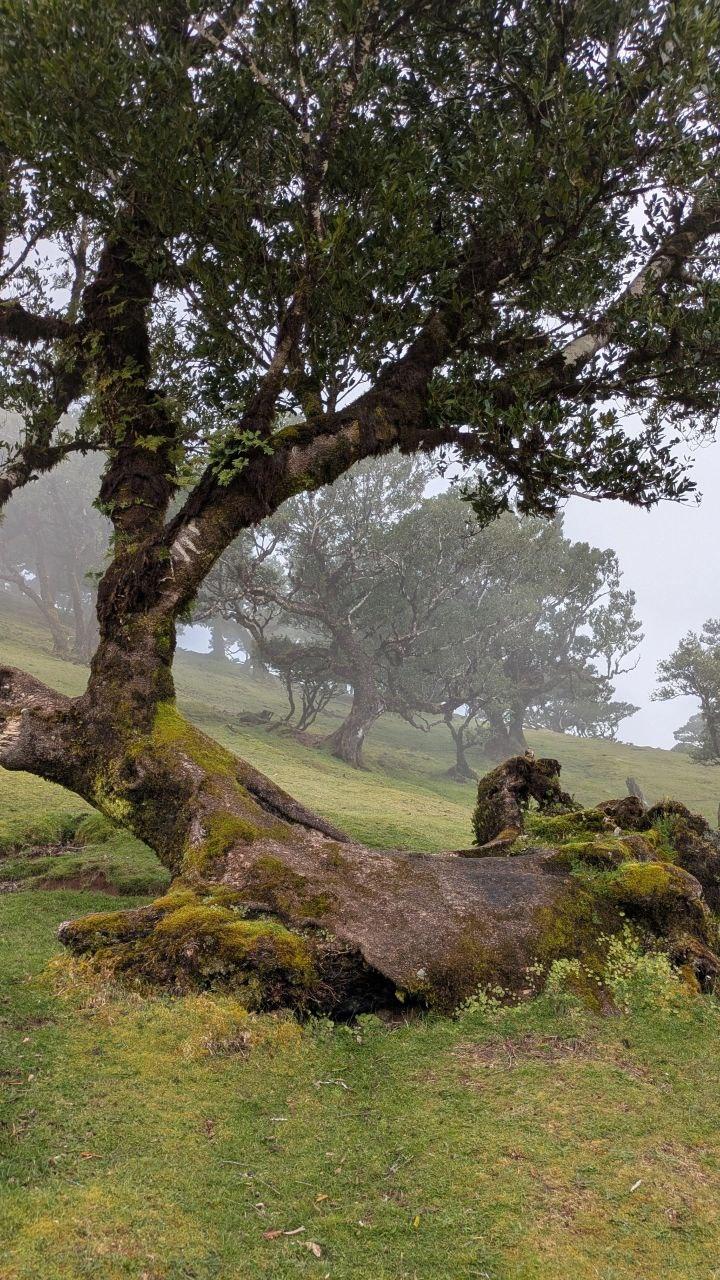
Note only, no attribution required: Laurisilva Fanal, Flyeva, CC0 1.0, Wikimedia Commons https://commons.wikimedia.org/wiki/File:Laurisilva_Fanal.jpg
Carnivorous plant found in Fanal: why Madeira's laurel forest needs us to bring nothing in
A South African sundew was found planted at Fanal in October 2026. What happened, what Madeira's law says and how hikers can help protect the laurel forest.
In October someone left a present in the Fanal forest that nobody wanted: a South African carnivorous plant, tucked into the wild vegetation as if it belonged there.
Fanal is the misty plateau in the north-west of Madeira, in the municipality of Porto Moniz, famous for its old til trees (Ocotea foetens, one of our native laurels). It sits inside the Madeira Natural Park and the Laurisilva, our native laurel forest. For anyone who has stood there in the fog, it feels like the last place on earth someone would bring a potted plant. Here is what happened, why it matters, and a few easy habits for the trail.
Key facts
• What: one Cape sundew (Drosera capensis), a carnivorous plant native to South Africa, was found and removed at Fanal in mid-October 2026 (reported by DIÁRIO de Notícias da Madeira, 23 Oct 2026).
• Planted on purpose? A University of Madeira researcher said peat traces and the roots suggest so. Nobody has been identified.
• Spreading? No evidence so far, according to the same report.
• The rule: releasing any exotic species into nature in Madeira needs prior permission from IFCN, the regional nature conservation institute, under Regional Legislative Decree 17/2023/M. Species on the regional invasive list are banned outright.
• Why it matters: UNESCO calls the Laurisilva the largest surviving area of laurel forest, and names invasive and introduced species as a threat.
What was found
According to DIÁRIO de Notícias da Madeira, a single sundew of the species Drosera capensis was found and removed from a natural vegetation area at Fanal in mid-October 2026. Sundews are small carnivorous plants that catch insects on sticky hairs on their leaves. This one comes from South Africa.
Miguel Sequeira, a researcher at the University of Madeira, told the paper that traces of peat and the state of the roots suggest the plant was put there on purpose. The paper also reports it is not the first time: in 2018, exotic carnivorous plants were found in a protected area near Pico do Areeiro, and some of them had seeds.
Nobody has been identified, and the paper stresses there is no evidence the Fanal plant had started to spread.
Why one small plant matters
It is tempting to shrug. It is one little plant, and it was pulled out. But the worry is not this specimen; it is the habit.
The researcher's warning, as the paper reports it, is that some exotic species can adapt to Madeira's conditions, reproduce and form populations of their own, and that threatens biodiversity. Even well-meaning plant collectors can start that chain.
Madeira's laurel forest is especially worth protecting. UNESCO, which listed the Laurisilva as a World Heritage Site in 1999, describes it as the largest surviving area of a forest type that covered much of southern Europe 15 to 40 million years ago. It counts at least 76 vascular plant species endemic to Madeira in the protected area, more than 500 endemic invertebrates, and birds like the Madeira laurel pigeon (Columba trocaz). It also lists invasive species and species introductions among the threats to watch.
IFCN's invasive species page says invasive species are one of the main threats in the Madeira archipelago, and that invasive animals in particular have badly damaged natural habitats, sometimes driving native species to extinction.
We have seen this along the levadas for decades. Plants that escaped from gardens now line long stretches of path, and once they settle in, getting them out is slow, expensive work. Nobody planted those to cause harm either.
What the law says
The regional law is Regional Legislative Decree 17/2023/M (Decreto Legislativo Regional) of 11 April 2023, which governs exotic species in Madeira and puts IFCN in charge. As DIÁRIO de Notícias da Madeira summarised it in its fact-check:
- Species on the Regional Invasive Species List (Lista Regional de Espécies Invasoras) may not be released into nature, nor kept, sold, transported or grown, except under the law's own exceptions. IFCN publishes the list on its website.
- Any other exotic species needs IFCN's prior authorisation before it goes into nature. The applicant must show clear benefits, that no native species would do the job, and a favourable risk analysis.
- In classified areas such as Fanal, the introduction must also be the only effective way to protect nature or public health and safety.
Releasing a listed invasive species is a "very serious" offence; releasing another exotic species without permission is "serious". The paper reports fines for individuals of €500 to €5,000 for serious offences through negligence and €1,000 to €10,000 when deliberate, and says very serious offences can reach €30,000. IFCN handles the cases, and enforcement is shared with other bodies, including the GNR and PSP police.
So no, the forest is not a garden anyone can add to.
How we can be good guests
None of this needs a botany degree. These are the habits I keep, and they cost nothing:
- Bring nothing living into the forest. No cuttings, seeds, bulbs or "rescued" houseplants. Under the law above, that needs IFCN's permission anyway.
- Take nothing living out either. Moss, ferns and seedlings belong where they are.
- Check your boots and gear. This one is my own habit, not an IFCN rule: I brush mud and seeds off my boots before driving up to a new area, especially after walking past garden escapes. It takes a minute.
- Stick to the paths. At Fanal I keep to the worn tracks so I'm not stepping on young plants or the roots of the old til trees.
- If something looks out of place, say so. Don't dig it up yourself. Note where it is, take a photo and tell IFCN (phone +351 291 145 590, weekdays 9:00–12:30 and 14:00–17:30, as listed on its website).
If you're heading up, the Vereda do Fanal (PR 13) trail page has the route and today's status, and the Vereda do Areeiro (PR 1) page covers the area of the 2018 find.
The person who planted that sundew probably thought they were adding something beautiful. Fanal is already beautiful without it. I'd rather bring up my attention and leave with only photos and wet socks.
Quick answers
What plant was found in Fanal? A Cape sundew (Drosera capensis), a small carnivorous plant from South Africa, found and removed in October 2026.
Is it illegal to plant exotic plants in Madeira's laurel forest? Yes, without IFCN's prior permission. Species on the regional invasive list are banned outright (Regional Legislative Decree 17/2023/M).
Has the sundew spread at Fanal? There was no evidence of that when it was reported.
Who do I tell if I see a plant that looks out of place? IFCN, on +351 291 145 590 during office hours. Note the spot and take a photo rather than pulling it up.
Sources
- DN Madeira fact-check, 23 Oct 2026 (find, researcher quote, 2018 Areeiro case, law summary, fines): https://www.dnoticias.pt/app/2026/10/23/510153-existem-leis-que-proibem-a-introducao-de-plantas-exoticas-na-laurissilva-da-madeira/ | Decreto Legislativo Regional 17/2023/M: https://diariodarepublica.pt/dr/detalhe/decreto-legislativo-regional/17-2023-211580660 | IFCN invasive species page (threat statement, phone, hours; read via Wayback copy of 15 Mar 2026): https://ifcn.madeira.gov.pt/pt/biodiversidade/especies-invasoras.html | UNESCO, Laurisilva of Madeira (1999, largest surviving laurel forest, 15-40 Ma, 76 endemic vascular plants, 500+ endemic invertebrates, invasive species threat): https://whc.unesco.org/en/list/934